
August 2025 to present
AI Index for Australia
Research Assistant · Trustworthy Digital Society (UNSW × UTS)
One of two engineers building AI Index Australia, a public dashboard and data platform for AI-related research activity in Australia. I contribute research data pipelines, cross-source linkages, and a config-driven frontend on a shared React, FastAPI, and PostgreSQL stack hosted on ARDC Nectar.
My contributions
- ORCID ingestion for talent mobility.
- PATSTAT ingestion and DOCDB patent-family methodology.
- OpenAlex linked to Scimago and CORE rankings, with a DBLP FTS5 index for messy conference names.
- Config-driven frontend architecture across 37 charts.
- Auth0 SSO, email verification, and a PostgreSQL user allowlist.
Overview
AI Index Australia is a public dashboard and data pipeline for AI-related research and activity in Australia. It is built through Trustworthy Digital Society, a joint UNSW and UTS initiative. The platform integrates eight external datasets and serves interactive visualisations over publications, grants, patents, and talent mobility.
I am one of two engineers on the platform. The work is shared: I own specific pipelines, linkages, and frontend architecture pieces described below. I do not claim sole ownership of every dataset integration or every chart on the site.
See the official UNSW project page for a walkthrough of the dashboard.
My contributions
Within the engineering team, my contributions include:
- ORCID data ingestion for talent mobility analysis (researcher movement into and out of Australia).
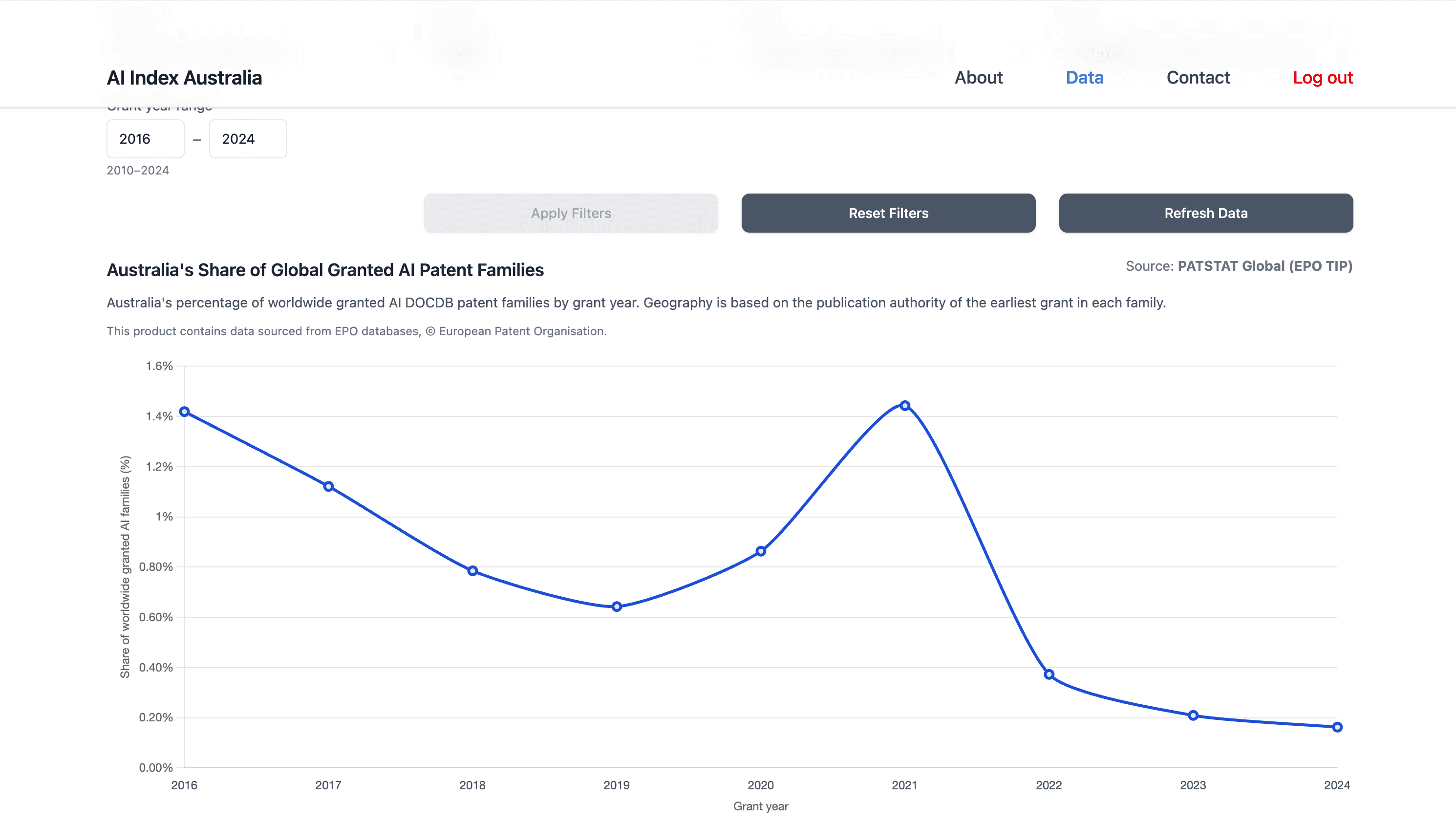
- PATSTAT ingestion and DOCDB patent-family methodology for international patent family views.
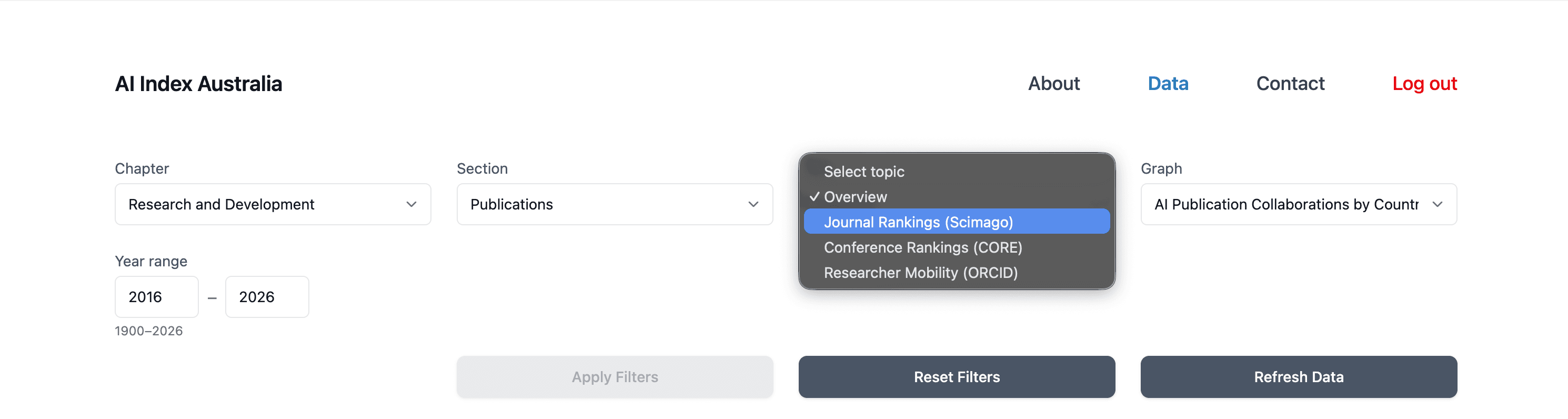
- Linking OpenAlex publications to Scimago journal rankings and CORE conference rankings.
- DBLP XML ingestion into a local SQLite FTS5 search index, with title normalisation, token-based matching, and year proximity. Records below the matching threshold stay unranked rather than receiving an unreliable ranking.
- A configuration-driven frontend architecture used across 37 charts, so new visualisations can be added through configuration instead of one-off frontend rewrites.
- Auth0 SSO with email verification, plus a PostgreSQL-backed user allowlist that gates access to the data pages.
Conference matching needed the DBLP index because venue names are inconsistent: the same conference appears as an abbreviation, a full name, with or without a year, in forms that never match on simple string comparison. Leaving low-confidence matches unranked was a deliberate choice so quality signals stay trustworthy.
The dashboard
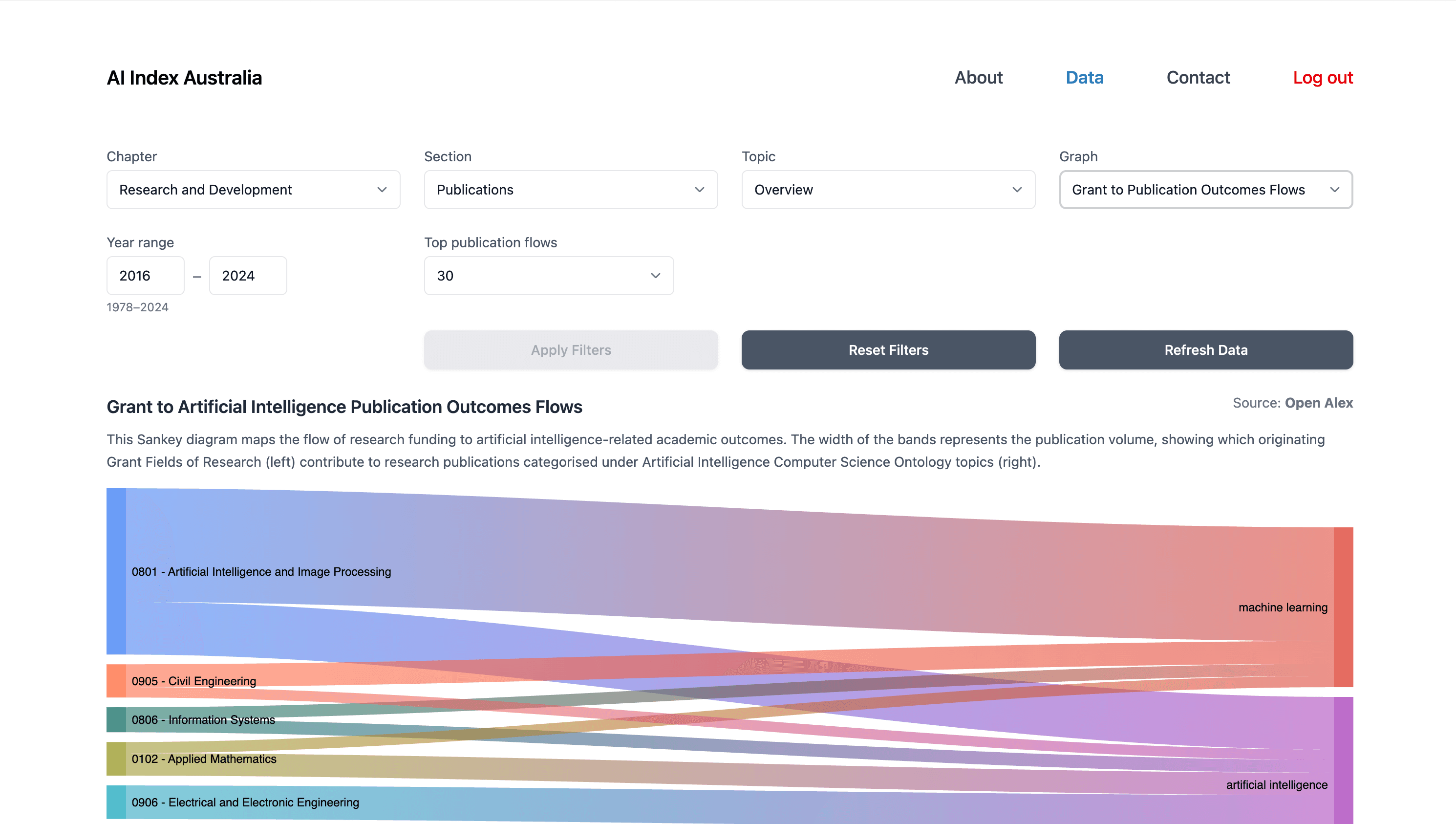
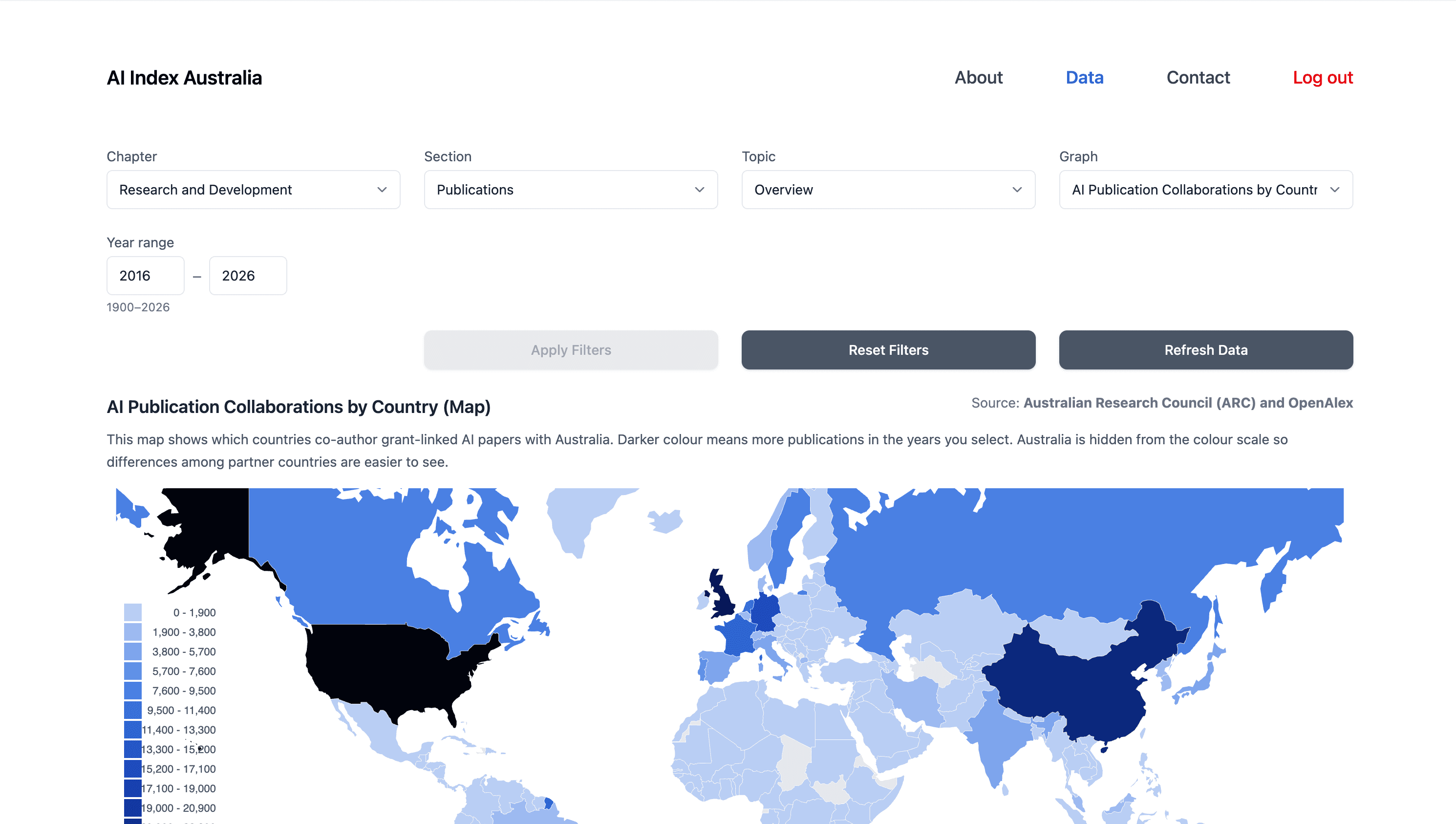
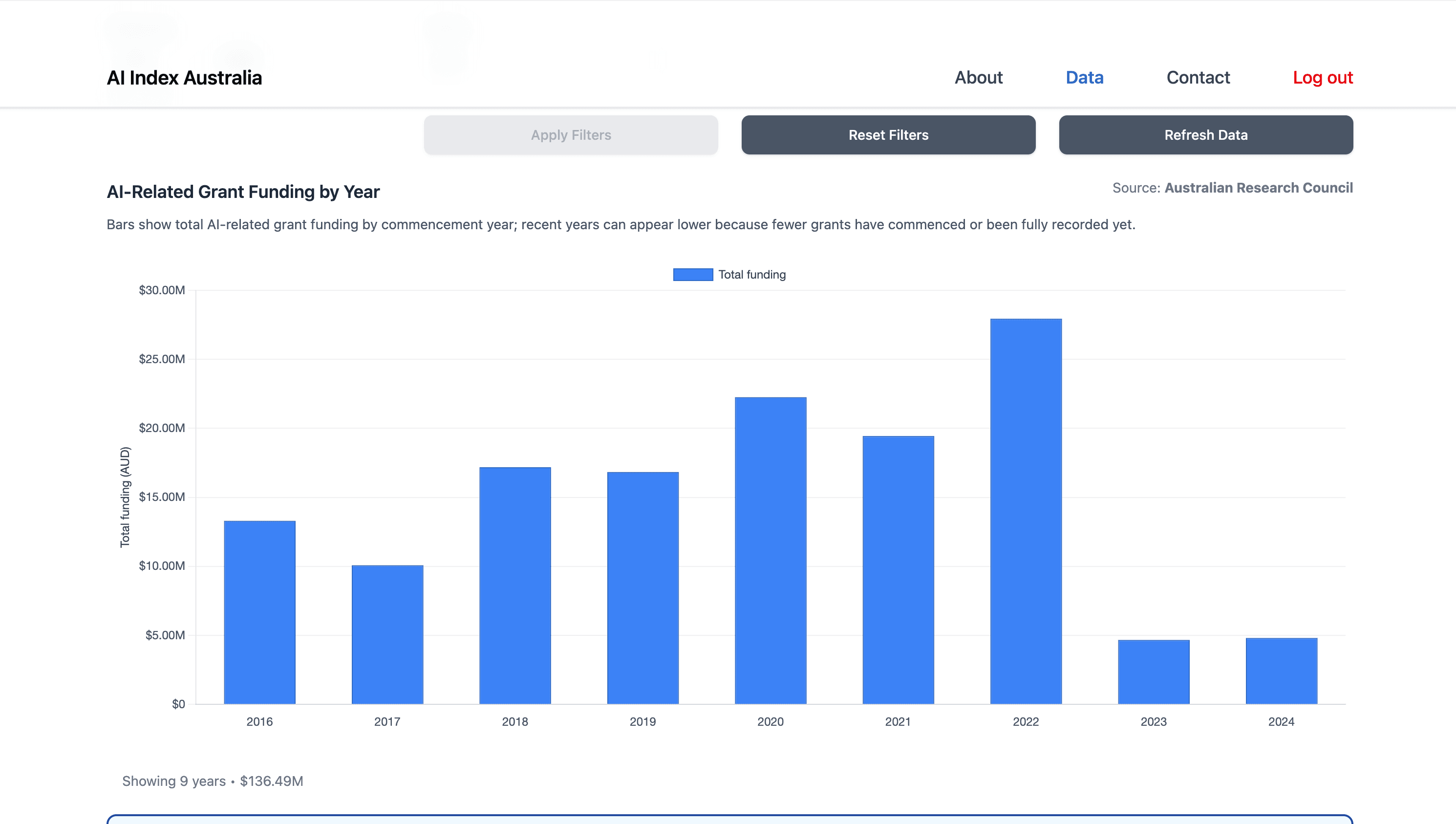
Researchers and stakeholders can filter by year, topic, and visualisation type, then explore the underlying data. Access uses two layers: Auth0 SSO with email verification, and an email allowlist stored in PostgreSQL. Stakeholder access is provisioned by adding professional emails to that list before sign-up.
Stack and infra
The stack includes a React and TypeScript frontend, a Python and FastAPI backend, PostgreSQL, ingestion pipelines, and chart visualisations. Everything runs on ARDC Nectar: compute VMs, the database, object storage, and the production site.
Pipeline work uses Python, pandas, SQLAlchemy, and Postgres, with OpenStack Swift for object storage. The web app uses React, TypeScript, Vite, and Tailwind, with Chart.js, Recharts, and D3. Auth0 handles authentication. Deployments go through Docker and GitLab CI. Sources include OpenAlex, ORCID, ARC, Scimago, CORE, IP RAPID, PATSTAT, and DBLP.